

STARSIL Hemostat® : Supporting Adhesion Prevention
STARSIL Hemostat ® is a topical hemostatic agent designed to support rapid control of bleeding during surgical procedures.

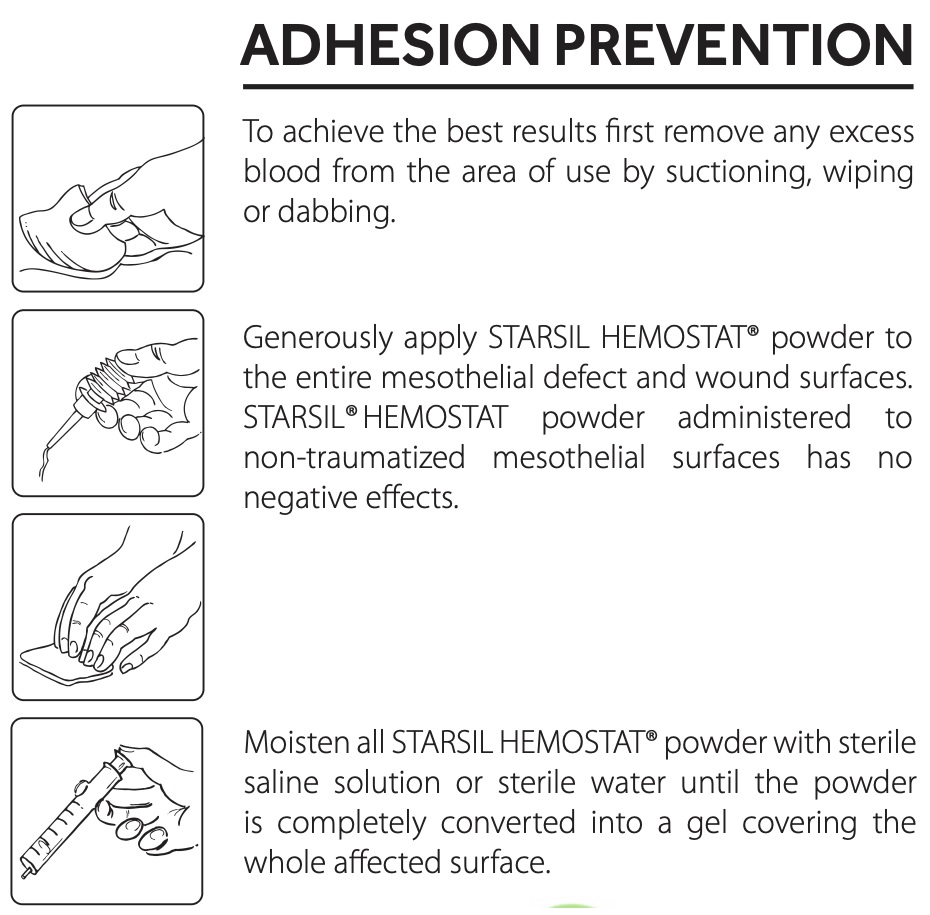
In addition to its hemostatic properties, Starsil Hemostat® may contribute to the reduction of postoperative adhesions by forming a temporary protective barrier at the application site.
When applied to tissue surfaces, Starsil Hemostat® creates a thin, biocompatible layer that helps separate neighboring tissues during the critical early phase of healing. This physical barrier may reduce direct tissue contact, which is one of the key factors in adhesion formation. By supporting effective hemostasis and maintaining localized tissue separation, Starsil Hemostat® can assist surgeons in managing surgical sites where adhesion prevention is a consideration.
Starsil Hemostat® is intended for use in a wide range of surgical specialties where bleeding control and gentle tissue management are important.
The material is designed to be easy to apply and to integrate into standard surgical workflows.
Dual Role: Hemostasis and Tissue Protection
Predictive factors for adhesion
- Extend and duration of the surgical procedure and tissue manipulation
- Incomplete hemostasis
- Total mass of blood and serosanguineous fluid resulting in a fibrin clot
STARSIL HEMOSTAT® PROVIDES EFFECTIVE AND FAST BLEEDING CONTRO
- Damage of the tissue by electrocautery
STARSIL HEMOSTAT® HELPS TO MINIMIZE USE OF ELECTROCAUTERY
- Extend and duration of the surgical procedure and tissue manipulation
STARSIL HEMOSTAT® FORMS A BARRIER TO ADHESION FORMATION
- Extend and duration of the surgical procedure and tissue manipulation
STARSIL HEMOSTAT® DOES NOT CAUSE FOREIGN BODY REACTIONS
Postoperative Adhesions: Overview and Burden

Incidence and Burden
Adhesions are one of the most common long-term complications of surgery:
Up to 90% of patients develop adhesions after major abdominal or pelvic surgery.
In gynecologic surgery, adhesion rates may reach 60–90%, depending on the procedure and surgical technique.
Adhesions are responsible for:
Chronic pelvic or abdominal pain
Infertility and subfertility
Small bowel obstruction
Dyspareunia
Increased risk and complexity of repeat surgeries
Longer operative times and higher healthcare costs
Adhesion-related complications often appear months or years after surgery, creating a significant long-term burden for both patients and healthcare systems.
Relevance in Gynecologic Procedures
Postoperative adhesions represent a significant clinical and economic burden in gynecology. Effective bleeding control and temporary tissue separation during early healing are key factors in reducing adhesion risk. Starsil Hemostat®, through its hemostatic action and localized protective effect, may support surgeons in managing surgical sites where adhesion prevention is a priority.
Given the high prevalence and long-term consequences, adhesion prevention should be considered an integral part of surgical planning and intraoperative management.
Gynecologic procedures frequently involve delicate pelvic organs and peritoneal surfaces, which are highly susceptible to adhesion formation Starsil Hemostat® may be particularly valuable in gynecologic surgeries where adhesion risk is high, such as:
Myomectomy
Endometriosis surgery
Ovarian cystectomy
Hysterectomy
Fertility-preserving and reconstructive procedures
In these settings, the use of a topical hemostatic agent that also provides a temporary physical barrier can complement meticulous surgical technique and minimally invasive approaches.

Starsil Hemostat® as Part of a Multimodal Adhesion
Prevention Strategy
Adhesion prevention is most effective when multiple measures are combined. Starsil Hemostat® is intended to be used as an adjunct to:
Careful and atraumatic surgical technique
Minimization of tissue ischemia and desiccation
Effective infection control
Appropriate use of barrier-based solutions when indicated
Incorporating Starsil Hemostat® into surgical workflows may contribute to improved healing conditions and reduced adhesion-related complications.
Effective Hemostasis
When applied to tissue surfaces, Starsil Hemostat®:
Promotes rapid local hemostasis, reducing blood accumulation
Helps limit fibrin deposition, a major precursor of adhesions
Forms a thin, temporary protective layer over the treated area
Supports gentle tissue management during the early healing phase
Topical hemostatic agents may therefore play a supportive role in adhesion prevention when used appropriately.
Physical Barrier Methods
Barrier agents are designed to temporarily separate tissue surfaces during early healing. These may include:
Films
Gels
Solutions or sprays
By combining bleeding control with localized tissue coverage, Starsil Hemostat® may assist in reducing direct tissue-to-tissue contact during the critical postoperative window.